
Introduction
This report presents key findings from a Inner Development Goals (IDG) meta-analysis conducted in March 2026. The study aggregates self-assessments from approximately 3,200 individuals across five continents, collected over the past two years. Respondents rated themselves on 25 core inner skills organized into five dimensions: Being, Thinking, Relating, Collaborating, and Acting.
The analysis highlights the global top 4 and bottom 4 skills and examines regional differences with a focus on Global North vs. Global South.
By combining robust data with interpretive insights and hypotheses, this article aims to spark meaningful reflection and conversation on what these patterns reveal about our collective strengths and gaps and, most importantly, to propose practical actions that can support humanity’s inner growth in an increasingly complex world.
The Big Picture: Human DOING vs Human BEING
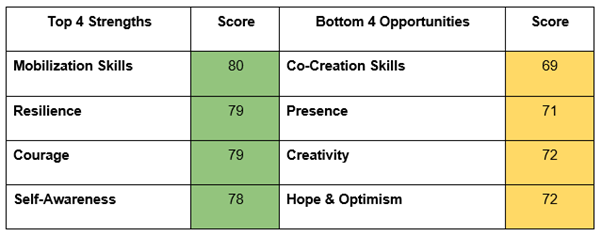
The data shows a striking pattern: humanity rates itself highest on Mobilization Skills, Resilience, Courage and Self Awareness while scoring lowest on Co-Creation, Presence, Creativity and Hope & Optimism.
What is Going on?
- We have been conditioned to operate as “Human Doings” rather than “Human Beings”
Modern society celebrates constant action, resilience, productivity, and results. Mobilization, the drive to rally others and push forward, is highly rewarded in workplaces, education, and media. This creates a strong action bias: we feel competent and valuable when we are DOING. Yet the same conditioning makes us deeply uncomfortable with slowing down, simply being present, or reflecting without immediate output – BEING. Presence requires tolerating stillness and uncertainty, exactly what our “get things done” culture trains us to avoid. - Discomfort with presence directly suppresses creativity
When we cannot comfortably slow down and be present, the mental space needed for genuine creativity shrinks. Creativity thrives in open, reflective states, not in frantic “action mode.” Our obsession with immediate results and measurable output leaves little room for the messy, non-linear process of imagining new possibilities.
- We approach collaboration through a win-lose lens instead of a co-creative one
Most people have been socialized to see collaboration as a negotiation where someone wins and someone loses, or where power must be managed and protected. This mindset blocks the psychological safety, trust, and shared ownership required for true co-creation. We excel at mobilizing others toward our goals (high Mobilization), but struggle to co-create something genuinely new together.
Implications & Ways Forward
These findings do not suggest we need less doing. They reveal that we need to do differently : to shift from reactive, disconnected action to Doing from Being: action that emerges from presence, awareness, and deeper alignment.
The real opportunity is not to choose between doing and being, but to integrate them so that our action is wiser, more creative, and more collectively effective.
- Move from “Human Doings” to “Doing from Being”
Instead of glorifying constant busyness, we must build cultures and systems where action is rooted in presence. This means redesigning workplaces, meetings, education, and leadership practices to regularly create space for reflection, deep listening, and stillness as the foundation for better doing. Organizations that introduce “presence pauses” before important decisions, or unstructured thinking time will likely discover that their action becomes more focused, creative, and impactful. The goal is not less mobilization, but mobilization that arises from a deeper, more conscious place. - Treat Presence as the soil for Creativity and Wise Action
When presence is underdeveloped, creativity and wise decision-making suffer. By intentionally cultivating presence, we create the inner conditions from which genuinely innovative and regenerative doing can emerge. This integration allows us to move faster when needed, but with greater clarity and alignment. - Evolve Collaboration from Win-Lose Negotiation to Co-Creative Emergence
We must shift our collaborative default from power management and negotiation to shared sensing and co-creation. When groups learn to pause together in presence, they become capable of generating solutions and direction that no single party could have produced alone. This is where true collective intelligence arises – doing from being, together.
Overall Strategic Opportunity
The IDG data invites us to transcend the outdated binary of “doing versus being.” The future belongs to those who master Doing from Being, where presence, reflection, and awareness become the source of more effective, creative, and regenerative action. This integration represents one of the highest-leverage shifts available to individuals, organizations, and societies today.
Additional finding
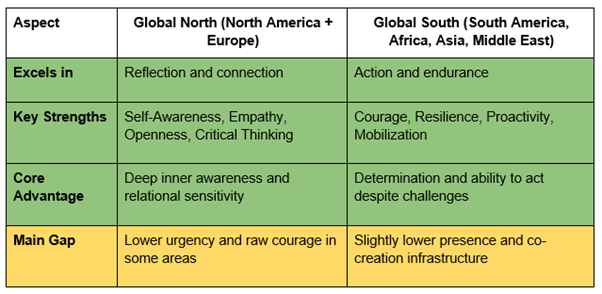
Global North vs Global South: Beautiful Complementarity
What might be going on?
The Global North’s relative material stability and formal education systems create the conditions for deeper reflective and relational capacities. In contrast, the Global South’s lived experience of complexity, constraint, and adversity has cultivated remarkable courage, resilience, and mobilization under pressure.
At the same time, many Global South cultures have long drawn upon rich wisdom traditions such as Ubuntu, Buen Vivir, and indigenous relational ontologies that naturally nurture presence, co-creation, interconnectedness, and a more holistic way of being.
Rapid modernization, urbanization, and the widespread influence of Western models may be weakening access to these traditions, particularly among younger generations, before alternative reflective practices have fully matured.
This creates a compelling invitation: rather than viewing one as “ahead” and the other as “behind,” we have a rare opportunity to engage in genuine mutual exploration. Through thoughtful North–South exchanges, the North can learn from the South’s embodied courage and adaptive resilience in the face of real challenges, while the South can draw on the North’s structured approaches to reflection, self-awareness, and critical thinking. Together, we can co-create new pathways that integrate the best of both – reawakening ancient wisdom while developing modern tools for presence, creativity, and true collaboration.